
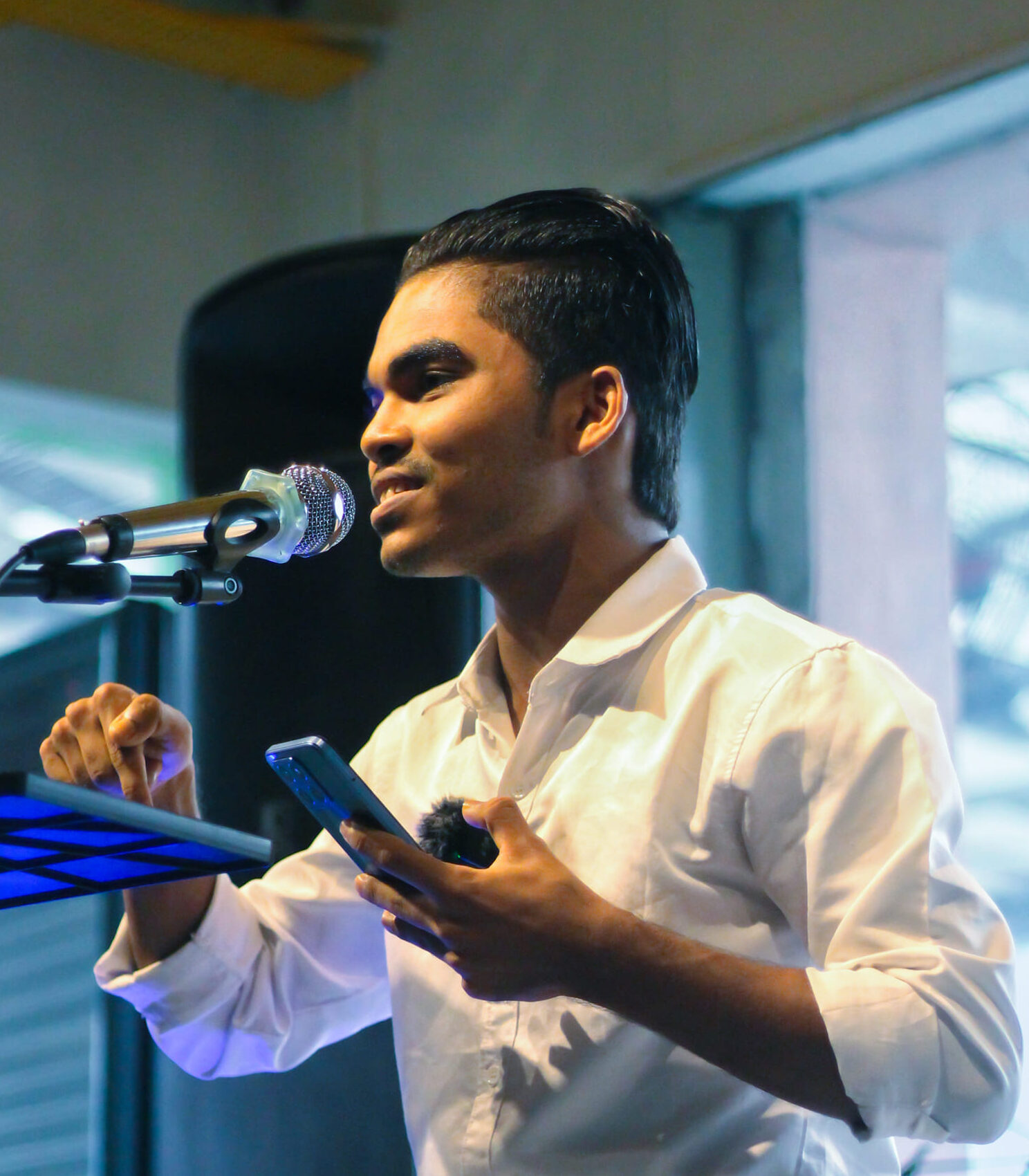
I was born in a land that belongs to me and my Rohingya people. It’s very well known as Arakan state in Myanmar. It is where my ancestors lived for generations with peace and freedom of movement. It is where our roots were planted for the very first, where our culture blossomed, and where my parents gave me birth and my childhood memories ended with both happiness and hardship. But today, I carry deep sorrow for being that land a place of bloodshed and genocide and a place where my people were slaughtered, shot with guns, killed and displaced most of the time and especially in 2017.
"I was at the age of 14 when Myanmar military unleashed genocide upon us. I lived through it. You may consider me as a witness, not only as a survivor".
For decades, we, the Rohingya people have faced systemic discrimination and stripped of our identity, our rights, and our homes. We are very well known as a Muslim minority in the history of the country, Myanmar. Since the 1960s, Myanmar’s military regimes have steadily escalated efforts to marginalize, exclude, and destroy us.
The military government, is known as the Tatmadaw. In 1982, they institutionalized our exclusion with the Citizenship Law, which effectively made us totally citizenship-less and stateless. They tried to erase our identity from official records. Propaganda painted us as “Bengali”. Even though we have been living in Arakan state, Myanmar for centuries, they were told that we don’t belong to the country. “But in fact there are a lot of our history which prove whom the country belongs to”.
"Before 2017, our persecution was systematic and consistent. From forced labour under the military junta to recurring waves of violence in the 1970s, 1990s, and 2012, we were treated like foreigners even though it was our own land".
Our movement was restricted. We needed permission to marry, to go village to village, to go town to town and we were denied access to healthcare, education and many others. And still, we tried to live. We tried to survive ahead like others. But the slow suffocation of our rights eventually became into full-scale extermination and genocide.
2017, it marked the darkest chapter in our history. The United Nations and human rights organizations documented the mass killings, violence used as a weapon of war, and the destruction of entire villages. The UN Fact-Finding Mission concluded that Myanmar’s military acted with “genocidal intent.”
These crimes were not committed by the military alone. Local officials and radical Buddhist monks were together, spreading dangerous propaganda for years.
Over 700,000 Rohingya people were fled to Bangladesh in 2017 forcibly. Today, nearly a million live in the world’s largest refugee camps in Bangladesh.
Today in Bangladesh and around the world we are safe from bullets, but not from misery. The camps are overcrowded, with limited access to education, healthcare, clean water, and hope. Our homes are gone. Our citizenship revoked. Our future, uncertain. We are like birds without nests, stateless, rootless and rejected.
We cannot return home because our homes no longer exist. Our citizenship has been stripped, our villages erased, and our safety is not guaranteed by anyhow. Yet we are not accepted since we fled in 2017. Now we are either like not human beings.
Countless of our brothers and sisters have tried to escape the camps, only in search of peaceful life but no body supports us to accept and no one treats us with love and respect. Many were lost at sea. Others disappeared.
Our voices are not hearable, no one hears our voices, no one cares about us, only everyone makes us poor and treats us like not human beings.
Yet, the World is silent to see and hear the suffering of us. Strong evidence, satellite images, eyewitness accounts, and the cries of survivors but the world’s response has been heartbreakingly slow .
The International Court of Justice (ICJ) has been hearing the case since 2017 which brought by The Gambia, accusing Myanmar of genocide, is still ongoing. But justice is still far away.
We Call On:
The World:
We are calling out the world to hear our voices, to look at us for justice, dignity and humanity.
The United Nations:
Use your authority to ensure ICJ rulings and establish a clear path for justice and accountability for survivors.
The International Criminal Court (ICC):
Investigate crimes against humanity and prosecute those responsible for mass atrocities, no matter their rank. We believe in you.
ASEAN and the Organization of Islamic Cooperation (OIC):
Stop hiding behind neutrality. Regional bodies must pressure Myanmar diplomatically and economically to ensure Rohingya rights are restored.
World Governments:
Continue providing humanitarian assistance, but more importantly to push for structural change and protection for our people.
Civil Society, You and Reading This:
Share our stories, raise voices, and remind your governments that silence in the face of genocide is complicity. We are human beings like you all. We deserve a brighten future. And we should not be forgotten from the world. We must be able to live our lives like you all in the world.
Dear Roshidullah,
You story made my day so special with new energy to do work more for my people.
I encourage & appreciate for your hard work that explained in very simply to get your words to the world.
I just love some of your lines that the challenges faced by my community (Rohingya) which i would like to use in my story to represent my community so is it permissionable?
You can respond me by my mail.
Thank You
Mohd Enamul
India
Please check your mailbox, i have done my response to you in your email. Thanks